Warner Bros. Discovery: What is Paramount buying?
NASDAQ:WBD - Warner Bros. Discovery Inc.

Investment Summary
Paramount's proposed acquisition of Warner Bros. Discovery (WBD) represents a bet on the long-term value of the company’s streaming scale and intellectual property catalogue rather than on the company's recent financial performance.
While WBD continues to face headwinds from declining linear television revenues and elevated debt levels, several factors suggest the company has become a more attractive asset than its recent earnings history may imply.
First, Warner Bros. Discovery owns one of the entertainment industry's most valuable portfolios of intellectual property, including HBO, Warner Bros., DC Comics, Harry Potter, Game of Thrones, and CNN. These assets provide multiple avenues for monetization across streaming, film, television, gaming, licensing, and consumer products.
Second, the company's multi-year deleveraging programme has materially strengthened its balance sheet. Long-term debt has fallen by more than $16 billion since 2022, while management has improved the profitability of its streaming operations and continued generating meaningful free cash flow.
Third, despite declining revenues, WBD appears well positioned to benefit from long-term industry trends, including streaming growth, digital advertising expansion, and increased monetization of premium content libraries. Management believes the media industry is undergoing a structural transformation rather than a cyclical downturn, creating opportunities for scaled content owners.
Finally, the company's sharp share price recovery over the past year and the premium implied by Paramount's offer suggest investors increasingly view Warner Bros. Discovery as a turnaround story rather than a distressed asset.
The acquisition therefore appears less focused on near-term earnings and more focused on securing strategic assets that could strengthen Paramount's competitive position in a rapidly evolving media landscape.
However, questions remain over how the merged company would deal with the ongoing decline of the traditional linear television business, which remains WBD’s largest source of revenue and cash flow, as well as the fierce competition from larger and more established streaming platforms such as Netflix and Disney.
Business Overview
Warner Bros. Discovery (WBD) is a global media and entertainment company operating across television networks, film production, streaming, gaming, news, and sports.
Formed through the $43 billion merger of WarnerMedia and Discovery in 2022, the $66.36 billion market cap[1] company combines some of the industry’s most recognizable content brands, including HBO, Warner Bros., CNN, Discovery Channel, DC Comics, and TNT Sports.
For Paramount, the strategic appeal of WBD lies in the breadth and quality of its content portfolio. The company owns one of the largest libraries of film and television content in the industry, alongside globally recognized franchises such as Harry Potter, Game of Thrones, and The Lord of the Rings production rights. These assets can be monetized across multiple channels, including streaming subscriptions, theatrical releases, television licensing, gaming, consumer products, and advertising-supported platforms.
The company employed 35,500 people at the end of 2025[2] and operates through three primary segments: streaming, which consists of the company’s premium pay-tv and streaming services; studios, which covers the production and distribution of film, television, and gaming content; and global linear networks, which primarily consists of domestic and international television networks.

While streaming currently makes up the smallest operating segment by revenue generation, WBD’s streaming platforms serve more than 140 million subscribers globally, making it one of the few media companies with sufficient scale to compete directly with Netflix and Disney.
The proposed $110.9 billion acquisition therefore represents an opportunity for Paramount to significantly expand its streaming reach, content library, and intellectual property portfolio.
Industry & Competitive Position
The global media and entertainment industry is undergoing a structural transition driven by the rapid shift from linear television to digital streaming, alongside the rising importance of advertising-supported digital platforms and data-driven content distribution.
The industry is valued at approximately $2.8 trillion in 2026 and is expected to grow to $4.6 trillion by 2035, according to Business Research Insights[3], driven by streaming subscriber monetization, digital advertising growth, and AI-enabled personalization across gaming and film entertainment. Within this environment, WBD operates as a hybrid legacy-digital business.

Management has consistently argued that the current disruption reflects a structural reconfiguration of the industry rather than a cyclical downturn.
During the company’s first-quarter 2026 earnings call[4], CEO David Zaslav (pictured left) described the environment as “a period of historic disruption in media and entertainment,” highlighting the accelerating change in content creation, distribution, and consumption.
From an acquisition perspective, this means that WBD’s value is increasingly tied to its ability to repurpose large-scale intellectual property across multiple distribution channels as the industry fragments.
Management continues to emphasise that the company retains multiple growth levers even in a structurally pressured environment.
Jean-Briac Perrette, CEO and president of Global Streaming & Games, noted that WBD still has “multiple different levers of growth,” including stronger content offerings, expanding advertising revenue, and improving engagement metrics across its platforms.
Competitive pressure, however, remains intense and multi-layered. WBD competes directly with traditional media players like Comcast and Paramount Global as well as streaming-first peers including Netflix and Disney, all of which are investing heavily in content, bundling strategies, and advertising-supported streaming tiers.
In parallel, tech platforms such as Amazon and Apple have increasingly embedded entertainment offerings within broader ecosystem strategies, further intensifying competition for both viewer attention and subscription spend.

While WBD has emerged as one of the industry's leading streaming players, it still trails the largest platforms. As of 2026, Netflix remains the global market leader with approximately 325 million subscribers[5], followed by Disney+ with 131.6 million subscribers. WBD’s streaming business has surpassed 140 million subscribers, placing it ahead of Paramount+ at roughly 79 million subscribers.
A key differentiator for WBD is its aforementioned list of globally recognized franchises, as well as premium content giant HBO with series such as Succession, House of the Dragon, The White Lotus, and Euphoria reinforcing subscriber retention and pricing power.
Furthermore, unlike many competitors that rely heavily on licensed content or fragmented IP portfolios, WBD retains significant ownership over its core intellectual property, allowing it to monetize content across multiple channels, including theatrical releases, streaming, television syndication, gaming, consumer products, and licensing agreements.
In the context of an acquisition, WBD’s scale in streaming and its deep IP portfolio position it as a strategically valuable asset despite an environment of intense structural disruption and aggressive competition.
Financial Performance
WBD’s recent financial performance reflects a transition phase in which improving cash generation and balance sheet repair coexist with structurally declining legacy revenues.
For a potential acquirer such as Paramount, the key implication is that near-term earnings volatility masks a more stable underlying cash flow profile supported by large-scale intellectual property monetisation.
In 2025, WBD generated $37.29 billion in revenue, down from $39.32 billion in 2024 and a peak of $41.32 billion in 2023[2]. The decline reflects continued pressure in the company’s global linear networks segment, which remains the largest contributor to revenue at $17.7 billion in 2025, but is structurally exposed to audience fragmentation and advertising migration to digital platforms.
This contrasts with more resilient, but smaller, revenue contributions from studios ($12.6 billion) and streaming ($10.9 billion), which better reflect the company’s long-term strategic direction.
Among WBD’s peer group, revenue growth is mixed. For example, Paramount’s revenue declined 2.56% in the last three years[6], while Comcast’s grew 1.76%[7]. Disney and Netflix fared significantly better, recording 6.22%[8] and 33.98%[9] increases, respectively, over the same period.
Despite revenue pressure, profitability metrics improved materially in 2025, with WBD reporting net income of $727 million versus an $11.31 billion net loss in 2024.
However, this improvement was driven largely by non-recurring items rather than revenue growth. The prior-year loss included a $9.1 billion goodwill impairment related to television assets, while 2025 benefited from approximately $2.9 billion in gains on debt extinguishment. As a result, headline earnings improvement overstates the extent of underlying operational acceleration.
A more relevant signal for acquisition analysis is cash generation. Free cash flow was $3.1 billion in 2025[2], compared to $4.4 billion in 2024[11]. This level of cash generation, combined with ongoing deleveraging, suggests the business is increasingly capable of self-funding operations while continuing to reduce financial risk.
Indeed, long-term debt has declined to $32.4 billion in 2025[2] from $48.9 billion in 2022[10], reflecting a sustained multi-year balance sheet repair program.
Margin structure also reflects this transition. Total costs and expenses represented 71.2% of revenue in 2025, producing $738 million in operating profit. This is significantly improved from recent years, with costs exceeded revenues in 2024 (125.4% of revenue)[5] and 2023 (103.7%). Compared with peers, WBD’s cost absorption remains broadly competitive, with Comcast, Disney and Paramount recording higher cost ratios of 83.3%[7], 85.4%[8], and 96.9%[6], respectively.
From a balance sheet perspective, WBD’s 12-month average financial leverage ratio of 0.24[2][12][13][14] compares favourably with Comcast (0.31)[7][15][16][17] and Netflix (0.51)[9][18][19][20].
The company also holds approximately $5 billion in excess cash as of Q1 2026[12], equating to 7.5% of its market capitalisation, providing a meaningful liquidity buffer and optionality for continued debt reduction, reinvestment, or shareholder returns. In comparison, Comcast and Netflix have excess cash to market cap ratios of 5.7%[15] and 3.6%[18], respectively.
Capital allocation has increasingly shifted toward shareholder returns alongside deleveraging. In Q1 2026, WBD repurchased $1.3 billion of stock, with $6.8 billion remaining under its existing authorization. While still secondary to balance sheet repair, this signals growing confidence in the stability of cash flows and reinforces the view that the company is transitioning from restructuring mode toward capital return discipline.
Overall, WBD’s financial profile is best characterized as a stabilizing cash-generative business with structurally declining legacy revenues, offset by improving balance sheet strength and emerging streaming scale.

Valuation & Stock Performance
The market seems to be shifting from viewing WBD as a post-merger restructuring story, to pricing it as a strategically valuable IP and streaming asset with improving financial stability, but persistent structural risk in legacy operations.
For a potential acquirer such as Paramount, this shift in market perception is as important as the underlying financial metrics, as it signals how much value the market already attributes to WBD’s content library and streaming scale.

Over the past 12 months, WBD has delivered a modest total shareholder returns (TSR) of 1.67%, compared to a negative 1.17% over a three-year horizon[21]. Peer performance has been similarly subdued, with Comcast posting a negative 0.23% one-year TSR and negative 0.25% over three years[22][23], while Netflix has recorded negative 0.34% and 1.09% over the same respective periods[24]. Collectively, the sector has lagged broader equity market performance.
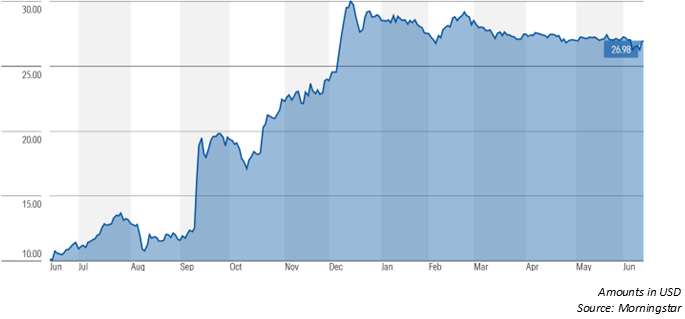
Despite weak absolute returns across the peer group, WBD’s equity performance has been driven by a notable re-rating over the past year.
After trading below $10 per share during the first half of 2025, the stock soared to around $26 by mid-2026[21] as investors responded positively to the company’s improving streaming profitability, ongoing debt reduction efforts, and strategic initiatives aimed at unlocking shareholder value.
More recently, progress towards a potential acquisition by Paramount has acted as an additional catalyst. The prospect of consolidation within the media sector has reinforced investor focus on WBD’s underlying strategic assets rather than short-term volatility in linear advertising or legacy network financial performance.
From a valuation perspective, WBD continues to trade between traditional media and pure-play streaming peers, reflecting its hybrid business model.
The company’s 12-month price-to-book ratio of 2.08[21] sits above Comcast at 0.99[22] but remains substantially below Netflix at 10.87[24], indicating that the market assigns a moderate premium to its asset base and turnaround potential but does not yet fully price it as a high-growth streaming compounder.
Similarly, its 12-month price-to-sales ratio of 1.84[21] compares to Comcast’s 0.72[22] and Netflix’s 7.41[24], reinforcing its positioning as an intermediate valuation case between legacy media compression and premium streaming multiples.

Overall, the market has begun to recognise the strategic value of WBD’s content and streaming platform, but continues to apply a meaningful discount due to structural headwinds in legacy media and uncertainty around the speed and durability of its digital transition.
Corporate Governance
WBD’s governance structure reflects a post-merger organisation still in transition, with a board and leadership framework shaped by the 2022 combination of WarnerMedia and Discovery.
From an acquisition perspective, governance is less about day-to-day operational control and more about assessing management alignment, oversight quality, and the potential for a successful integration with Paramount.
The board currently consists of 13 directors, with an average age of 65.2 years[25].

Leadership has been centralised since the 2022 merger, with David Zaslav serving as President and CEO. Zaslav previously held the same roles at Discovery and continues to serve on external boards, including Grupo Televisa and Sirius XM Holdings[25].
Chairman John Di Piazza has also held his role since the 2022 merger and brings prior senior experience at Citigroup and PricewaterhouseCoopers[25].
The separation of Chairman and CEO roles is maintained, although this structure is not mandated by the company’s bylaws[26], meaning it could be altered through board-level decisions without formal governance restructuring.
The board operates on a declassified structure, with all directors standing for annual election[25]. This is intended to increase accountability relative to staggered boards and provide shareholders with regular opportunities to influence board composition.
At the most recent annual meetings, average shareholder support for directors reelections declined from 92.6% in 2025 to 84.7% in 2026[27][28], indicating a modest deterioration in overall investor confidence in certain aspects of board performance.
While Zaslav continued to receive overwhelming backing, with support only declining slightly from 97.4% to 96.6%, several directors experienced much sharper drops. Most notably, Paul Gould’s support fell from 86.6% to 48.2%, while Anthony Noto’s declined from 70.6% to 59.2%.
At the same time, some directors, including Di Piazza, saw improved support, rising to 98.2%, indicating that shareholder concerns are not uniform and are likely focused on specific governance decisions rather than systemic dissatisfaction with the board as a whole.
From an acquisition standpoint, the recent dispersion in director support highlights that investor expectations around oversight, execution discipline, and long-term value creation remain active considerations that Paramount would need to address in its governance design.
Shareholder Rights & Ownership
WBD’s shareholder base is dominated by large institutional investors, with the top five institutions collectively controlling more than one-quarter of outstanding shares.
This level of concentration gives a relatively small group of asset managers significant influence over key governance outcomes, including board elections, compensation policies, and ultimately any post-transaction control considerations and remaining regulatory milestones.
In contrast, insider ownership remains below 1%, indicating that management has limited direct economic exposure to equity performance. While this is not unusual for large-cap media companies, it does increase the importance of external governance mechanisms and shareholder engagement in aligning management incentives with long-term shareholder value creation.
In the context of the now-approved acquisition, low insider ownership also suggests minimal structural resistance from management to the completion of the transaction, with incentives increasingly aligned toward deal closure and transition execution.

Shareholders approved the Paramount acquisition in April 2026 with overwhelming support, clearing the principal governance hurdle for the transaction and leaving regulatory approval as the final hurdle for the transaction.
As a result, shareholder rights mechanisms such as voting thresholds and nomination procedures are no longer central to deal uncertainty, but remain relevant for understanding baseline governance structure and post-merger transition dynamics.
WBD does not offer formal proxy access rights, meaning shareholders cannot directly include their own nominees in company proxy materials under a standardised proxy access framework. Instead, shareholders must rely on advance notice provisions within the bylaws to nominate directors[26].
The nomination window for the 2026 annual meeting has passed, with the meeting itself scheduled for June 9. However, shareholders will be able to submit nominations for the 2027 annual meeting from February 9 to March 11, 2027[25].
A more significant governance feature is the threshold required for shareholders to call a special meeting. WBD requires ownership of at least 20% of outstanding shares held continuously for at least one year[26]. This is higher than thresholds commonly advocated by governance-focused investors, many of whom argue for a 10% threshold as a more balanced standard. In practice, this higher barrier reduces the likelihood of disruptive or opportunistic special meeting requests but also limits minority shareholders’ ability to escalate concerns between annual meetings.
However, assuming market regulators green light the Paramount transaction, both of these mechanisms are now largely transitional in nature rather than strategically determinative.
Overall, while WBD’s shareholder rights framework remains formally conventional but moderately restrictive, its practical relevance has shifted. With the Paramount acquisition now approved, governance risk has largely transitioned away from shareholder approval dynamics toward regulatory clearance and post-merger integration execution.
Like this article? Sign up for our free newsletter.
References
[1] On June 9, 2026, Financial Times (https://markets.ft.com/) listed the market capitalization for Warner Bros. Discovery Inc (WBD) stock as $66.36 billion.
[2] “Warner Bros. Discovery 2025 Annual Report” (HTM). February 27, 2026. Retrieved June 6, 2026.
[3] “Entertainment and Media Market” www.businessresearchinsights.com. May 25, 2026. Retrieved June 6, 2026.
[4] “WBD Q1 2026 Earnings Call Transcript” www.fool.com. May 7, 2026. Retrieved June 6, 2026.
[5] “How Many Subscribers Do Netflix, Disney+, Amazon Prime Video & Other Streaming Services Have? (2026 Statistics)” www.sellcell.com. June 4, 2026. Retrieved June 6, 2026.
[6] “Paramount Skydance Corp 2025 Annual Report” (HTM). February 25, 2026. Retrieved June 6, 2026.
[7] “Comcast Corp 2025 Annual Report” (HTM). February 3, 2026. Retrieved June 6, 2026.
[8] “Walt Disney Co 2025 Annual Report” (HTM). November 13, 2025. Retrieved June 6, 2026.
[9] “Netflix Inc 2025 Annual Report” (HTM). January 23, 2026. Retrieved June 6, 2026.
[10] “Warner Bros. Discovery 2022 Annual Report” (HTM). February 24, 2023. Retrieved June 6, 2026.
[11] “Warner Bros. Discovery 2024 Annual Report” (HTM). February 27, 2025. Retrieved June 6, 2026.
[12] “Warner Bros. Discovery Q1 2026 Quarterly Report” (HTM). May 6, 2026. Retrieved June 6, 2026.
[13] “Warner Bros. Discovery Q3 2025 Quarterly Report” (HTM). November 6, 2025. Retrieved June 6, 2026.
[14] “Warner Bros. Discovery Q2 2025 Quarterly Report” (HTM). August 7, 2025. Retrieved June 6, 2026.
[15] “Comcast Corp Q1 2026 Quarterly Report” (HTM). April 23, 2026. Retrieved June 6, 2026.
[16] “Comcast Corp Q3 2025 Quarterly Report” (HTM). October 30, 2025. Retrieved June 6, 2026.
[17] “Comcast Corp Q2 2025 Quarterly Report” (HTM). July 31, 2025. Retrieved June 6, 2026.
[18] “Netflix Inc Q1 2026 Quarterly Report” (HTM). April 16, 2026. Retrieved June 6, 2026.
[19] “Netflix Inc Q3 2026 Quarterly Report” (HTM). October 22, 2025. Retrieved June 6, 2026.
[20] “Netflix Inc Q2 2026 Quarterly Report” (HTM). July 18, 2025. Retrieved June 6, 2026.
[21] “WBD - Warner Bros. Discovery Chart | Morningstar” www.morningstar.com. June 5, 2026. Retrieved June 6, 2026.
[22] “CMCSA - Comcast Corp Chart | Morningstar” www.morningstar.com. June 5, 2026. Retrieved June 6, 2026.
[23] “Comcast Corp (CMCSA) Dividends” www.dividendmax.com. May 13, 2026. Retrieved June 6, 2026.
[24] “NFLX - Netflix Inc Chart | Morningstar” www.morningstar.com. June 5, 2026. Retrieved June 6, 2026.
[25] “Warner Bros. Discovery 2026 Proxy Statement” (HTM). April 30, 2026. Retrieved June 6, 2026.
[26] “Second Amended and Restated Bylaws of Warner Bros. Discovery, Inc.” (HTM). June 2, 2025. Retrieved June 6, 2026.
UPDATED TO INCLUDE
[27] “Warner Bros. Discovery 2026 Annual Meeting Results” (HTM). June 12, 2026. Retrieved June 14, 2026.
[28] “Warner Bros. Discovery 2025 Annual Meeting Results” (HTM). June 3, 2025. Retrieved June 14, 2026.