

What is short selling?
Key takeaways: Short selling is the practice of borrowing shares and selling them in the hope of buying them back at a lower price. This strategy allows investors to profit from falling stocks, but it also carries unique risks and remains one of the most debated practices in finance.
Short selling is an investment strategy that allows investors to profit when a company’s share price falls.
While most investors buy shares hoping they will rise in value, short sellers take the opposite approach. They identify companies they believe are overvalued, facing significant business challenges, or potentially engaging in misleading practices, and position themselves to benefit if the stock declines.
The strategy is often associated with controversy because short sellers publicly criticize companies and stand to profit when share prices fall.
However, supporters argue that short sellers play an important role in financial markets by exposing risks, identifying fraud, and challenging overly optimistic narratives.
A useful example is Hindenburg Research’s campaign against Adani Group in 2023.
The short seller disclosed a short position and published a report alleging stock manipulation and accounting irregularities across the Indian conglomerate.
Adani denied the allegations, but the report triggered a sharp decline in the group’s market value and became one of the most widely discussed short-selling campaigns in recent history.
Who are short sellers?
Short sellers come in many forms, but the strategy is most commonly associated with hedge funds, specialist research firms, and professional investors that focus on identifying overvalued companies or uncovering potential risks.
Firms such as Muddy Waters Research, Citron Research, Spruce Point Capital Management, and Grizzly Research have built reputations by publishing detailed reports that challenge corporate disclosures, business practices, governance structures, or financial performance.

While specialist firms often attract the most attention, short selling is not limited to them.
Hedge funds, proprietary trading firms, institutional investors, and even individual investors may establish short positions when they believe a company’s share price does not accurately reflect its risks or fundamentals. In many cases, these investors never publish research or publicly disclose their views.
How short selling works
At its core, short selling involves selling shares that the investor does not actually own.
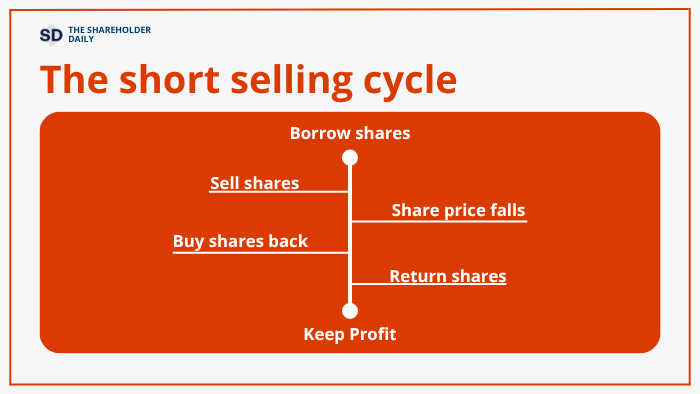
To do this, a short seller borrows shares from another investor, typically through a broker. The borrowed shares are then sold in the market at the current share price.
The short seller hopes the stock will subsequently decline in value. If it does, they can buy the shares back at a lower price, return them to the lender, and keep the difference as profit.
For example, imagine an investor borrows 100 shares of a company trading at $100 per share. The investor immediately sells those shares for $10,000.
If the stock later falls to $70 per share, the investor can repurchase the 100 shares for $7,000, return them to the lender, and retain the $3,000 difference before fees and borrowing costs.
However, the obligation to return the borrowed shares remains regardless of what happens to the stock price. If the shares rise instead of fall, the short seller must still buy them back.
Suppose the stock rises from $100 to $150. The short seller would now need to spend $15,000 to repurchase shares that were originally sold for $10,000, resulting in a $5,000 loss. If the stock continued rising to $200 or $300, those losses would become even larger.
This is one of the key differences between short selling and traditional investing. A long investor can lose no more than their initial investment if a stock falls to zero. A short seller, by contrast, can theoretically lose an unlimited amount because there is no limit to how high a stock's share price can rise.
Why investors short stocks
Short sellers typically focus on companies they believe are overvalued or facing problems that the broader market has not yet fully recognized.
These concerns can take many forms.
Some investors target companies they believe have unsustainable business models or unrealistic growth expectations. Others focus on accounting issues, governance concerns, excessive debt, weak competitive positions, or evidence that management may be misleading investors.
In the case of Adani Group, Hindenburg argued that the market was not properly accounting for what it described as governance and financial risks within the group. The firm believed the company’s valuation failed to reflect these concerns and positioned itself accordingly.
Like activist investors, which we covered in a previous article in the Learning Center, short sellers are ultimately expressing an investment thesis. The difference is that they believe a company’s shares should fall rather than rise.
Why short sellers publish reports
One of the most common questions investors ask is why short sellers publicly disclose their research.
The answer is relatively straightforward.
Short sellers generally establish their position before publishing a report. Once the report is release, other investors can evaluate the evidence and decide whether they agree with the analysis.
If investors conclude that the concerns are valid, they may decide to sell their shares while potential buyers may become less willing to purchase the stock. This can push the share price lower, allowing the short seller to profit.
This does not mean the allegations are necessarily correct. Some reports prove highly accurate, while others are disputed or ultimately proven wrong.
Investors must therefore evaluate the evidence carefully rather than simply accepting the conclusions of either the short seller or the company.
Hindenburg’s report on Adani provides a useful example. The publication of the report triggered intense scrutiny from investors, regulators, and the media, leading to significant volatility as markets assessed the competing claims.
What happens after a short report?
The publication of a short report is often only the beginning of the story.
Companies frequently issue detailed rebuttals, challenge the short seller’s claims, or threaten legal action. Investors then evaluate the competing arguments and determine whether the concerns are material.
In some cases, regulators launch investigations or request additional disclosures. In others, the controversy fades without any formal action.
Market reactions can be dramatic. Stocks targeted by short sellers often experience heightened volatility as investors reassess the company’s prospects and the credibility of the allegations.
Hindenburg’s campaign against Adani Group illustrates how this process can unfold.
After the report was published in January 2023, shares in Adani companies fell sharply, wiping out more than $100 billion in market value at one stage as investors reassessed the group’s risks.
Adani strongly rejected the allegations, describing them as baseless and publishing a lengthy rebuttal defending its governance, disclosures, and business practices.
The debate continued long after the initial selloff. Supporters of Hindenburg argued that the report had exposed important governance concerns, while Adani and its backers maintained that the allegations were flawed and politically motivated.
The outcome of any short campaign ultimately depends on whether the concerns raised by the short seller are substantiated and whether they materially affect the company’s future performance.
The risks of short selling
Short selling can be highly profitable, but it is also one of the riskiest strategies in investing.
For a traditional investor who buys shares, the maximum loss is limited to the amount invested. If a stock falls to zero, the investor loses 100% of their investment but no more.
Short sellers face a very different risk profile.
The maximum gain on a short position is limited because a stock can only fall to zero. However, potential losses are theoretically unlimited because there is no limit to how high a stock’s price can rise.

For example, a stock sold short at $100 could rise to $200, $500, or even $1,000, forcing the short seller to buy back the shares at increasingly higher prices.
This asymmetry makes risk management particularly important for short sellers.
What is a short squeeze?
A short squeeze occurs when a heavily shorted stock rises rapidly, forcing short sellers to buy shares in order to limit their losses.
Because short sellers must eventually repurchase borrowed shares, rising prices can create additional buying pressure. As more short sellers rush to close their positions, the stock can rise even further, creating a self-reinforcing cycle.
The most famous example is GameStop in 2021.
At the time, several hedge funds and other investors had built large short positions in the video game retailer, believing the company’s business faced long-term challenges.
More than 100% of GameStop’s publicly tradable shares had reportedly been sold short, a very unusually high level that attracted attention from retail investors.
Retail investors argued that if enough investors bought and held GameStop shares, they could force short sellers to repurchase stock at ever-higher prices, triggering a short squeeze.
GameStop’s share price surged from less than $20 at the beginning of January 2021 to an intraday high of more than $480 later that month. As the stock climbed, many short sellers were forced to close positions at substantial losses.
One of the most notable casualties was Melvin Capital, which required a multi-billion-dollar capital injection from its own investors and ultimately shut down in 2022. Estimates suggest short sellers collectively lost tens of billions of dollars during the squeeze as GameStop and several other heavily shorted stocks rallied sharply.
Are short sellers good or bad?
The role of short sellers remains a subject of debate.
Supporters argue that short sellers improve market efficiency by identifying fraud, highlighting governance failures, and exposing risks that other investors may overlook.
Several major corporate scandals, including Enron and Wirecard, were identified by skeptical investors long before regulators intervened.
Critics argue that short sellers may have conflicts of interest because they profit when share prices fall. Companies frequently accuse short sellers of presenting information selectively or exaggerating concerns in order to drive down stock prices.
Those concerns were highlighted by the case of Andrew Left, one of the best-known short sellers and founder of Citron Research.
In 2024, the U.S. Securities and Exchange Commission accused Left of misleading investors about his trading activity by publicly promoting positions and then rapidly trading in the opposite direction after stock prices moved. Left denied wrongdoing, but the case drew significant attention because it focused on the conduct of the short seller rather than the accuracy of his research.
In 2026, a jury found Left guilty on multiple securities fraud charges, though he has said he intends to appeal.
In reality, short sellers are neither inherently good nor bad. Like other investors, they are expressing a view about a company’s future value. Markets function most effectively when both optimistic and skeptical viewpoints can be evaluated openly.
The role of short sellers in modern markets
Short selling plays an important role in modern financial markets because it allows investors to challenge prevailing narratives and identify potential risks.
Without short sellers, markets would be dominated by investors whose financial interests depend on share prices rising. The presence of investors willing to take the opposite side can improve price discovery and help uncover information that might otherwise remain hidden.
For this reason, short sellers remain an important, if often controversial, part of the investment ecosystem.
Key takeaways
Short selling is the practice of borrowing and selling shares with goal of buying them back later at a lower price.
While controversial, short sellers can play an important role in financial markets by identifying risks, challenging management teams, and exposing potential problems before they become widely recognized.
Their success depends not on winning arguments, but on correctly identifying companies whose share prices ultimately decline in value.

