

What are leveraged buyouts?
Key takeaways: A leveraged buyout (LBO) is the acquisition of a company using borrowed money. Private equity firms use leverage to amplify returns, but higher debt also increases financial risk if the business underperforms.
A leveraged buyout (LBO) is the acquisition of a company using a combination of investor capital and borrowed money.
LBOs are the most common type of traditional private equity transaction and have been used to acquire some of the world's largest and best-known companies.
One of the best-known examples is Blackstone's acquisition of Hilton Worldwide in 2007.
The private equity firm purchased the hotel operator for around $26 billion using approximately $6 billion of equity and $20 billion of debt, before eventually exiting the investment at a substantial profit.
Understanding how LBOs work helps explain why debt plays such a central role in modern private equity investing.
What is a leveraged buyout?
An LBO is the acquisition of a company using a combination of equity and borrowed money.
Rather than paying the entire purchase price with their own money, private equity firms typically finance a significant proportion of the acquisition using debt, known as financial leverage.
While every transaction differs, a private equity firm might contribute around 30% of the acquisition price from its investors while borrowing the remaining 70% from lenders.
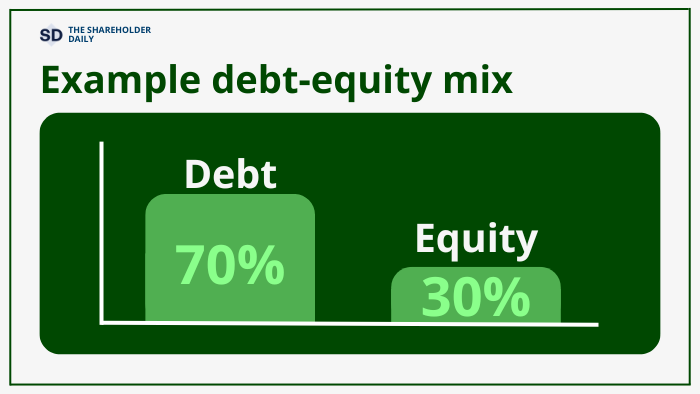
The exact financing mix varies depending on market conditions, interest rates, the quality of the business being acquired, and lenders' willingness to provide financing. During periods of low interest rates and abundant credit, transactions often use more debt than during tighter financial conditions.
Unlike a typical corporate loan, the debt is generally supported by the acquired company's assets and future cash flows rather than the private equity firm's own balance sheet.
As a result, the acquired business is responsible for generating enough cash to service interest payments and gradually repay the debt over time.
How does a leveraged buyout work?
Although every transaction is different, most LBOs follow a similar process.
First, a private equity firm identifies a company it believes can increase in value over time and raises equity capital from its investors, known as limited partners (LPs), while simultaneously arranging debt financing from banks, private credit funds, or other lenders.
Once financing has been secured, the private equity firm acquires the target company and begins implementing operational improvements designed to strengthen the business. These may involve increasing revenue, expanding into new markets, improving efficiency, strengthening management teams, or reducing unnecessary costs.
As the company generates cash flow, a portion of those earnings is often used to repay acquisition debt. Over time, reducing debt increases the amount of equity value owned by investors.
Finally, once the business has grown in value, the private equity firm exits the investment by selling the company, listing it on a stock exchange, or selling its stake to another investor.

A company's value depends not only on its earnings but also on the valuation investors assign to those earnings.
If a business becomes more profitable, more competitive, or more attractive to buyers, investors may be willing to pay a higher valuation multiple when the company is eventually sold.
Blackstone followed a very similar process when acquiring Hilton.
After completing the acquisition in 2007, the firm worked alongside management to navigate the global financial crisis, improve operations, reduce debt, and eventually return Hilton to the public markets at a significantly higher valuation.
Following Hilton's IPO in 2013 and a series of subsequent share sales, Blackstone completed its exit in 2018, realizing an estimated $14 billion profit on the investment, making it one of the most successful leveraged buyouts in private equity history.
Why use debt?
One of the most common misconceptions about LBOs is that private equity firms use debt simply because they do not have enough cash to buy companies outright.
In reality, debt is used because it can increase returns for equity investors when used responsibly.
Debt is generally less expensive than equity because lenders receive fixed interest payments and are repaid before shareholders if a company encounters financial difficulties. This lower cost of capital allows private equity firms to finance acquisitions more efficiently than relying entirely on equity.
Debt can also magnify investment returns, with debt repayments fueling equity gains over time.
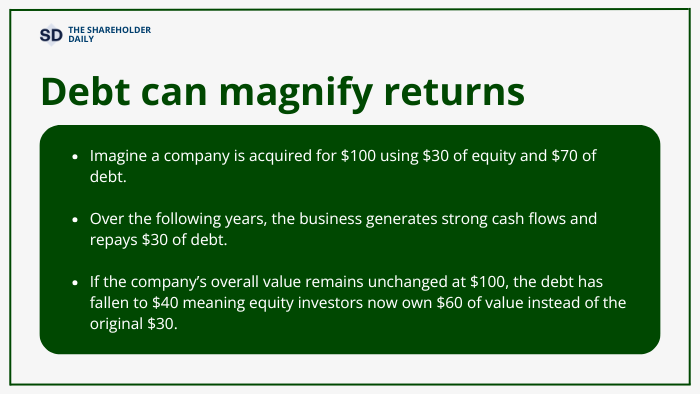
Of course, the opposite is also true. If the company performs poorly, excessive debt can quickly erode equity value and increase the risk of financial distress.
What companies make good LBO candidates?
Private equity firms generally target businesses that possess characteristics making them suitable for supporting acquisition debt.
These often include stable and predictable cash flows that can comfortably service interest payments, strong market positions with established customer bases, and relatively low capital expenditure requirements.
Other key factors include opportunities for operational improvements that could increase profitability, and businesses operating in mature industries with relatively predictable earnings.
Industries such as hotels, consumer brands, healthcare, and business services have historically produced many successful LBOs because they often possess these characteristics.
In contrast, early-stage biotech companies, pre-revenue tech firms, and highly speculative businesses are generally less suitable because their cash flows are uncertain and therefore less capable of supporting large amounts of debt.
Risks of leveraged buyouts
While LBOs can generate attractive returns, they also carry significant risks. The most obvious is excessive leverage.
Companies with large debt burdens remain responsible for making interest payments regardless of economic conditions. If earnings decline or borrowing costs increase, servicing that debt can become increasingly difficult.
Economic recessions can also reduce demand for a company's products or services, weakening cash flows at precisely the moment debt obligations remain fixed.
The collapse of Toys "R" Us illustrates these risks.
The retailer was acquired by a consortium of private equity firms in 2005 using a heavily leveraged transaction.
In the years that followed, the company struggled with changing consumer behavior, growing competition from online retailers, and the burden of servicing billions of dollars of acquisition debt.
Although many factors contributed to its eventual bankruptcy in 2017, the transaction remains one of the most widely cited examples of how excessive leverage can magnify financial difficulties when business performance deteriorates.
Hilton and Toys "R" Us therefore demonstrate the two sides of LBOs.
When operational improvements, debt reduction, and favorable market conditions align, leverage can significantly increase shareholder returns. When they do not, the same leverage can amplify losses and increase financial risk.
Key takeaways
LBOs are the most common type of traditional private equity transaction and rely on borrowed money to acquire companies.
When used successfully, leverage can amplify shareholder returns through operational improvements, debt reduction, and valuation growth.
However, because debt also magnifies financial risk, the success of an LBO ultimately depends on the acquired company's ability to generate sustainable cash flow and create long-term value.


