

What is private equity?
Key takeaway: Private equity firms acquire controlling stakes in companies, often using leverage, and work to increase value through operational improvements, debt reduction, and strategic changes. They raise capital from institutions and aim to exit investments at higher valuations over time.
Private equity is an investment strategy that involves buying ownership stakes in companies that are not publicly traded, or taking publicly listed companies private.
Unlike public market investors, who buy and sell shares on a stock exchange, private equity firms typically acquire significant or controlling stakes in businesses and take direct responsibility for management and strategic decision-making.
Today, private equity firms manage trillions of dollars globally and own thousands of companies across industries ranging from technology and healthcare to retail and hospitality. In fact, McKinsey’s 2026 Global Private Markets Report estimated that private markets topped $8.5 trillion in 2025.
A useful example is Blackstone's acquisition of Hilton Worldwide in 2007.
The private equity firm purchased the hotel operator in one of the largest buyouts of its time and remained involved through the financial crisis before eventually exiting the investment at a substantial profit.
The transaction remains one of the most successful private equity deals in history and illustrates many of the core principles behind the industry.
Who are private equity firms?
Private equity firms, typically referred to as general partners (GPs), identify investment opportunities and manage portfolio companies.
Some of the world’s largest alternative asset managers employ private equity investment strategies. Firms such as Blackstone, KKR, Apollo Global Management, Carlyle, and Thoma Bravo are among the most notable names in the industry.
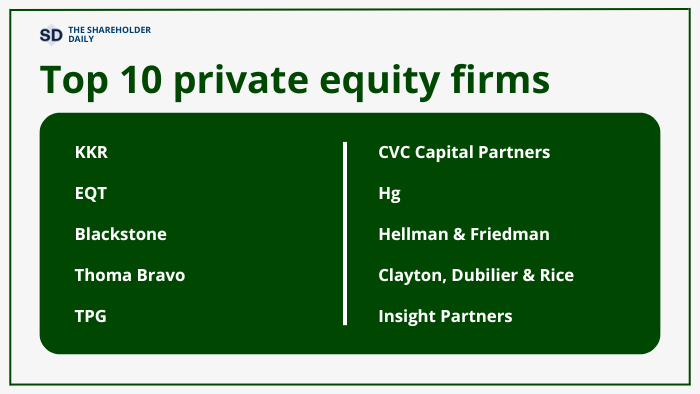
Alongside the largest alternative asset managers, the private equity industry includes a wide range of mid-market and specialist firms such as CVC Capital Partners, Advent International, Permira, EQT, and Hellman & Friedman, which focus on different regions, sectors, and deal sizes.
Collectively, these firms oversee hundreds of billions of dollars in assets and have become major participants in corporate acquisitions worldwide.
How does private equity work?
While individual transactions vary, most private equity investments follow a similar process.
First, a private equity firm launches a fund and raises capital from its investors, who are often referred to as limited partners (LPs) and typically include pension funds, insurance companies, sovereign wealth funds, university endowments, charitable foundations, and wealthy individuals.
Then, the firm identifies a company it believes has the potential to increase in value and acquires a stake in the business.
Often, a private equity firm will take full control of the company, which highlights an important distinction from activist investment strategies. Activist investors typically acquire minority stakes in publicly traded companies and seek to influence management decisions from the outside. Private equity firms, by contrast, usually acquire controlling stakes and take direct responsibility for strategy, operations, and capital allocation.
Management and investors can then start to work on improving performance through operational changes, strategic initiatives, acquisitions, or cost reductions.
Ideally, the firm then exits the investment for a profit by selling the company, listing it on a stock exchange, or selling its stake to another investor.
The Hilton transaction followed a similar path.
After acquiring the company for around $26 billion, financed with roughly $6 billion of equity from Blackstone and $20 billion of debt, Blackstone worked alongside management through the global financial crisis which served as an extremely challenging period for the global hospitality industry as travel demand collapsed.
As hotel markets recovered and Hilton expanded its operations, the company's value increased significantly, eventually allowing Blackstone to realize a substantial $26-28 billion in total value.
How do private equity firms make money?
While strategies vary, private equity firms generally create value through three primary mechanisms.

Operational improvement
One of the most important drivers of private equity returns is improving a company's performance.
This can involve increasing revenue, expanding into new markets, improving efficiency, reducing costs, or strengthening management teams.
Private equity firms often bring industry expertise, operational specialists, and strategic guidance to help portfolio companies grow more effectively.
In Hilton's case, Blackstone supported the company's growth and expansion while helping it navigate and ultimately survive the global financial crisis.
Debt reduction
Many private equity transactions involve borrowing money to help finance an acquisition.
As the acquired company generates cash flow, a portion of those earnings may be used to repay debt.
Over time, reducing debt increases the amount of equity value owned by investors.
For example, when a company is acquired using both equity and debt, the debt sits ahead of equity in the capital structure. This means lenders are repaid first if the company is sold or generates excess cash. As the business repays debt over time, the amount owed to lenders falls, and a greater proportion of the company’s value accrues to equity holders.
Valuation multiple expansion
A company's value is determined not only by its earnings but also by the valuation investors assign to those earnings.
If investors become more confident in a company's growth prospects, profitability, or competitive position, they may be willing to pay a higher price for each dollar of earnings the company generates. This is known as “multiple expansion.”
Private equity firms seek to improve both the company's performance and investor perception, potentially increasing the valuation at which the business can eventually be sold.
Hilton benefited from both stronger operating performance and a recovery in investor sentiment toward the hospitality sector, contributing to a significantly higher valuation over time.
Types of private equity investments
Private equity encompasses several different investment strategies.
Leveraged buyouts (LBOs)
Leveraged buyouts are the most widely recognized form of private equity investing.
In an LBO, a private equity firm acquires a company using a combination of its own capital and borrowed money. For example, a firm acquiring a company for $10 billion might contribute $3 billion of equity and borrow $7 billion to complete the transaction.
The acquired company's future cash flows are often used to help service and repay the debt.
LBOs generally make up the largest segment of traditional private equity.
Growth equity
Growth equity involves investing in companies that are already established but require additional capital to expand. Unlike buyouts, these investments are often minority stakes and generally involve less debt.
Growth equity sits between venture capital and traditional private equity, focusing on businesses that have moved beyond the startup stage but still have significant growth potential.
Take-private transactions
While take-private transactions are usually executed using leveraged buyout structures, they are commonly grouped separately because they involve the acquisition and delisting of publicly traded companies.
In a take-private transaction, a private equity firm acquires all of the shares of a publicly listed company and removes it from the stock market entirely.
These deals often attract significant media attention, particularly when they involve household-name companies or large acquisition premiums.
Carve-outs
A carve-out occurs when a corporation sells a division or business unit to a private equity firm, effectively carving out part of its business.
These opportunities can be attractive because the division may receive greater focus and investment under independent ownership.
Private equity firms often believe such assets can often get overlooked while remaining a part of the wider company and begin to flourish when independently managed.
Aside from these four key strategies, large alternative asset managers may also invest in infrastructure, private credit, real estate, and distressed assets, although these are often considered separate strategies from traditional private equity.
Why do companies go private?
Companies may choose private ownership for a variety of reasons.
Operating as a private company can provide greater flexibility to pursue long-term strategies without the pressure of quarterly earnings reports or daily stock market fluctuations.
Private ownership may also make it easier to restructure operations, invest in growth initiatives, or undertake significant changes that could be difficult to implement under public market scrutiny.
For some businesses, private ownership provides management with additional time and flexibility to execute a transformation strategy before eventually returning to public markets.
It is also worth noting that despite the clear perks of private ownership, companies typically go public to access deep capital markets, provide liquidity for shareholders and employees, and support long-term growth through broader investor participation.
Why private equity matters
Private equity has become an increasingly important part of the global economy, with private equity-owned companies employing millions of people worldwide and operating across every major industry.
Many well-known brands have spent time under private equity ownership, even if consumers were unaware of the change.
The industry’s influence extends beyond acquisitions. Large institutional investors, including pension funds, insurance companies, and sovereign wealth funds, allocate significant capital to private equity funds as part of their long-term investment strategies.
These investors are willing to accept reduced liquidity, meaning their capital is locked up for several years, in exchange for the potential for higher long-term returns compared with public markets.
As a result, private equity plays a major role in determining how capital is allocated throughout the economy.
Criticisms of private equity
Despite its popularity, private equity remains a subject of debate.
Critics argue that the use of leverage can increase financial risk, particularly during economic downturns. Others contend that some firms focus excessively on short-term cost reductions, layoffs, or asset sales at the expense of long-term investment.
Supporters, however, argue that private equity improves efficiency, strengthens corporate governance, and provides businesses with the capital and expertise needed to grow.
As with any investment strategy, outcomes vary considerably depending on the quality of management, the specifics of the transaction, and broader economic conditions.
Key takeaways
Private equity is ultimately a long-term ownership strategy built around buying companies, improving their performance, and selling them for a profit.
Unlike public market investing, where investors typically hold minority stakes and rely on market movements for returns, private equity firms take control of businesses and actively influence strategy, operations, and capital allocation to drive value creation.
The industry generates returns through a combination of operational improvement, debt reduction, and valuation changes, all of which are shaped by how effectively a company is managed during the period of private ownership.
While strategies vary, from leveraged buyouts and growth investments to carve-outs and take-privates, the underlying objective remains to improve a business and exit at a higher value.
Private equity has become a major force in global capital markets, attracting capital from some of the world’s largest institutional investors and ultimately influencing how companies are owned, financed, and managed.


